
the curing lab · Series 2 · Field Note #012
Every Coating Has a Thermal Personality
Can one cure schedule run every coating? Why color, gloss, film build, and finish change how a coating absorbs thermal energy.

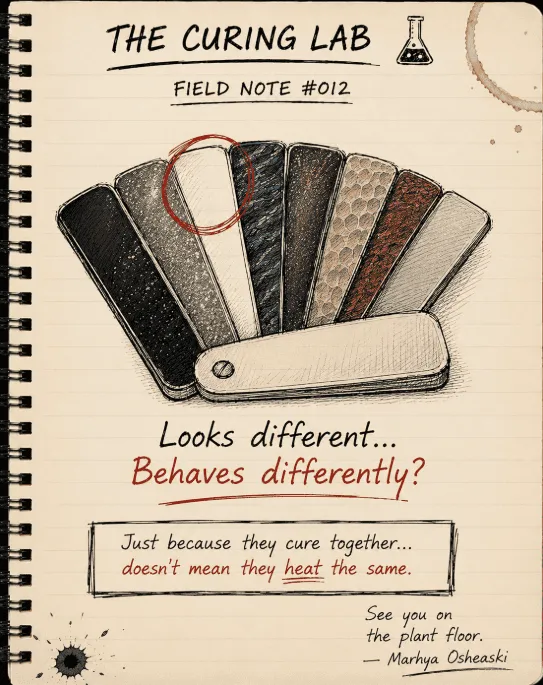
One question I’ve been asked more than once is:
“Can I run every coating using the same cure schedule?”
Maybe. Maybe not.
It’s easy to assume that if the chemistry is similar, the cure profile will be too. But coatings aren’t defined by chemistry alone. Color is another variable. But even within the aesthetic, there are many more factors to consider:
- Pigments.
- Metallics.
- Texture finishes.
- River finishes.
- Gloss level.
- Film build.
- Even the wavelength of the energy source can all influence how thermal energy is absorbed and distributed.
Every coating has its own thermal personality.
I’ve seen two coatings run through the same oven, on the same parts, under the same settings—and produce noticeably different curing behavior.
The oven didn’t change. The operators didn’t change. The coating did.
That doesn’t automatically mean one coating cures faster than another. It means they may not heat in exactly the same way.
That’s an important distinction.
In processes where infrared contributes significantly to heating, different coatings can absorb radiant energy differently. In convection-dominated systems, those differences may be much less noticeable because the primary heat transfer mechanism is the hot air heating the part.
The lesson isn’t that one coating is better than another. The lesson is that different coatings can respond differently to the same process.
That’s why I try not to assume. I measure.
Because coatings don’t care what we expect. They respond to the thermal history they actually experience.
The next time you change from one coating to another...
Don't just look at the color. Ask yourself:
"What changed that could influence how this coating receives thermal energy?"
Sometimes the answer is obvious. Sometimes it's something you've never considered.
Every coating has a thermal personality. Understand it before you assume it behaves like the last one.
Think about the last time your line changed coatings. Besides the color, what else changed?
- Pigments?
- Metallics?
- Texture?
- River finish?
- Gloss level?
- Film build?
- Chemistry?
- Substrate?
Now ask yourself:
“Could any of those have changed the coating's thermal response?”
If you discover something interesting, I'd love to hear what you found.