
the curing lab · Series 2 · Field Note #011
Find the Hardest Place to Heat
Coatings don't care how hot most of the part got. Why the hardest-to-heat spot decides whether your part is truly cured.

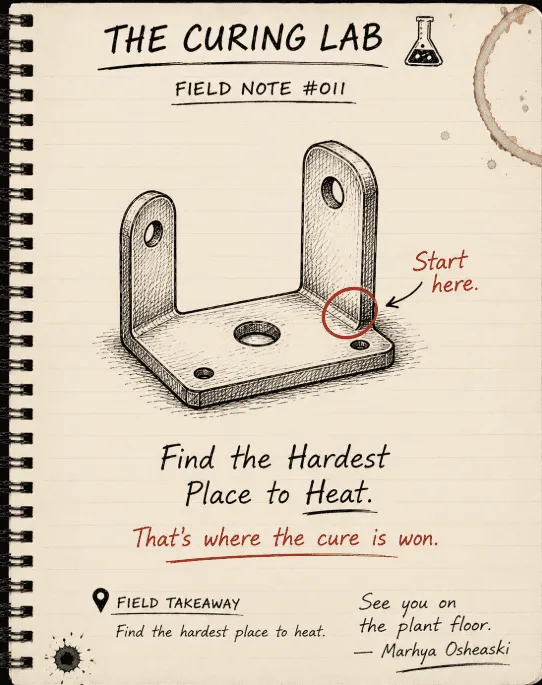
When I’m evaluating a curing process, I don’t spend much time looking at the hottest part of the temperature profile. I’m looking for something else.
The place that’s hardest to heat.
Because coatings don’t care how hot most of the part became. They care whether the critical areas received the thermal history required to fully cure.
That hardest-to-heat area could be:
- A thick flange.
- A hidden corner.
- A surface shielded from airflow.
- A location behind another part.
- An area with greater thermal mass.
I’ve seen parts that looked perfect.
The average temperature profile looked great. The oven was operating exactly as expected.
But one small area never received the thermal history the coating required. That one location determined the performance of the entire part.
That’s why experienced process engineers don’t chase averages. They look for the limiting condition. The area that’s most difficult to heat.
Because if you can successfully cure the hardest-to-heat location, you’ve greatly increased your confidence that the rest of the part has received the thermal history it needs.
The next time you're reviewing a temperature profile—or simply watching parts move through your curing oven—ask yourself:
"If I had to place one temperature probe, where would I put it?"
Now ask yourself why you picked that location. Your answer will tell you a lot about your process.
Don't chase the hottest spot. Find the hardest place to heat.
This week, choose one of your most challenging parts.
Before it enters the oven, point to the one location you believe will be the hardest to heat.
Then compare your prediction to your temperature data—or, if you don't have temperature data, inspect that area closely after curing and ask yourself why you chose it.
If you discover something interesting, I'd love to hear what you found.