

One of the first questions I hear when discussing a curing process is:
“How long does the part need to stay in the oven?”
It’s a logical question. But over the years, I’ve learned to ask a different one.
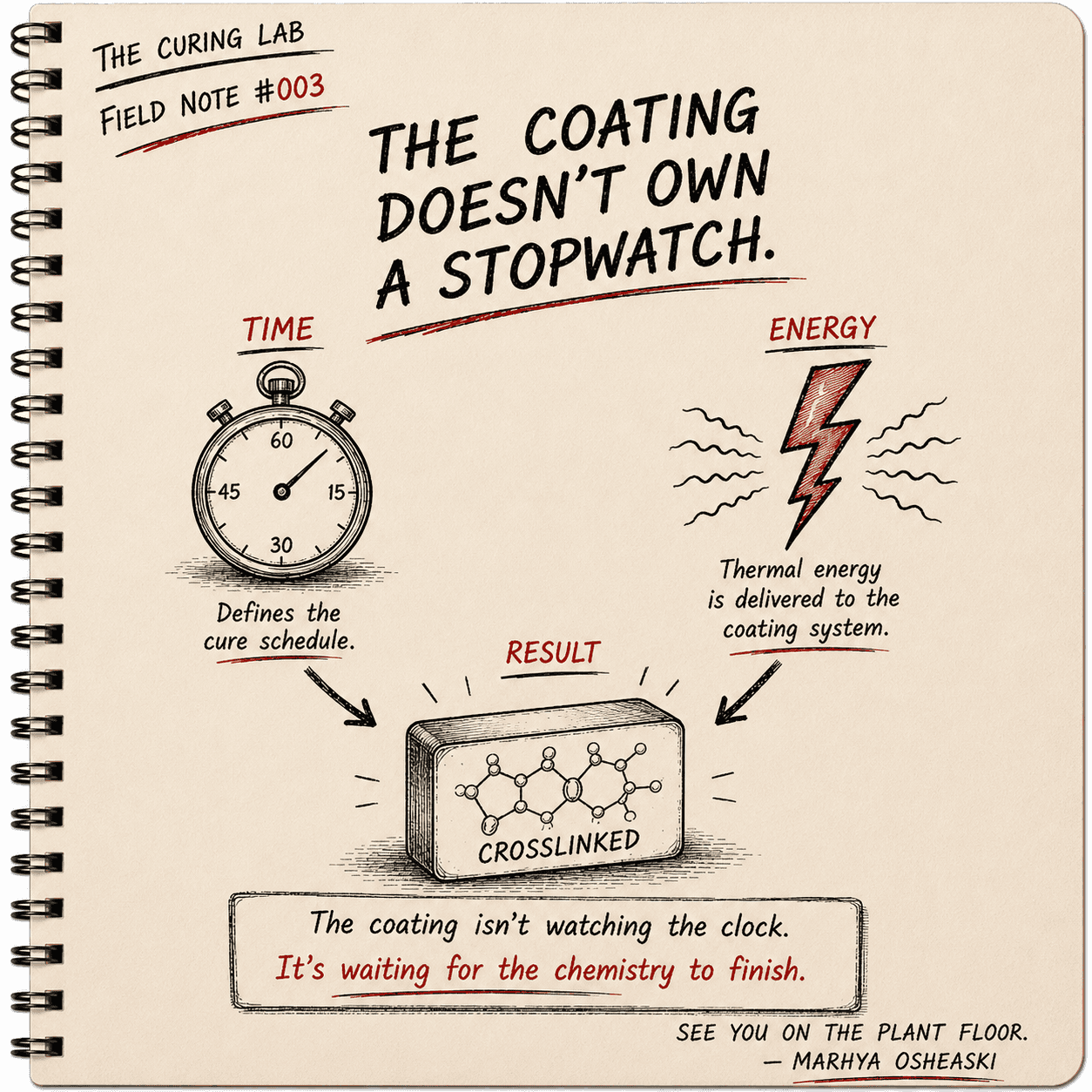
What thermal history does the coating need to reach a complete cure?
By thermal history, I mean the combination of temperature, time, and energy transfer the coating experiences throughout the cure cycle.
That question changes everything.
Because the coating isn’t responding to the clock. It’s responding to its thermal history.
In a conventional convection oven, the cure schedule is typically defined as time at Part Metal Temperature (PMT). The air heats the part, the part conducts thermal energy into the coating, and the chemistry progresses until the required cure is achieved.
Infrared follows a different path.
Instead of relying primarily on heated air, radiant energy is absorbed by the coating and the substrate, increasing the rate at which thermal energy is delivered to the system. That can increase the rate at which thermal energy is delivered to the coating system, allowing melt, flow, gel, and ultimately crosslinking to occur more rapidly when the process is properly designed.
Different heat transfer. Same chemistry.
Whether you’re using convection, infrared, or a combination of both, the objective never changes: Deliver the thermal energy required to achieve a complete cure.
Once you begin looking at curing through the lens of thermal history instead of simply oven time, you start asking better questions.
- Am I delivering thermal energy efficiently?
- Is my cure schedule appropriate for this part?
- Can the required thermal energy be delivered in a better way?
Those are the questions that lead to meaningful process improvements.