

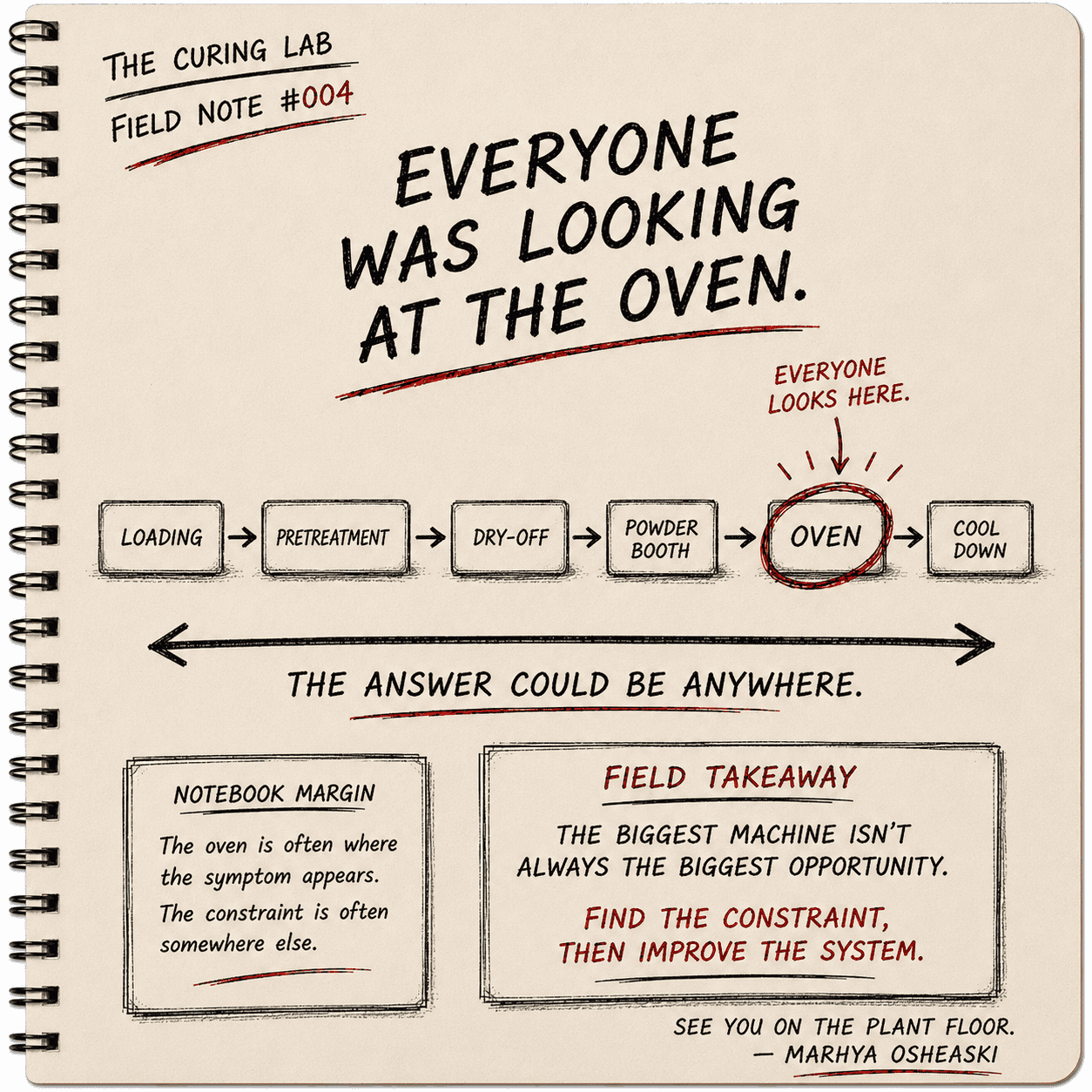
I’ve walked into a lot of manufacturing plants where the first thing someone says is:
“Our oven is the bottleneck.”
Sometimes they’re right. But not nearly as often as they think.
The oven is easy to notice.
It’s usually the largest piece of equipment on the line. It’s where the product spends the most time. So when production falls behind, it’s naturally the first place people look.
But over the years I’ve learned something.
The bottleneck isn’t always the process with the longest cycle time. It’s the process that’s limiting throughput.
That’s an important difference. I’ve seen manufacturers invest hundreds of thousands of dollars increasing oven capacity, only to discover the real constraint was somewhere else:
- Loading.
- Pretreatment.
- Dry-off.
- Grounding.
- Powder application.
- Part spacing.
- Material handling.
The oven wasn’t causing the problem. It was simply where the problem became visible. That’s an important distinction, because solving the symptom isn’t the same as solving the cause.
One of my favorite questions to ask during a plant walk is:
“If I doubled your oven capacity tomorrow, what process would be waiting next?”
That question usually changes the conversation.
Because every manufacturing line has one process that ultimately determines its maximum throughput. Finding that process is often far more valuable than upgrading equipment.
Every step influences the next:
- Loading affects pretreatment.
- Pretreatment affects coating quality.
- Coating affects curing.
- Curing affects cooling.
- Cooling affects packaging.
The best manufacturers don’t ask,
“How do we make this machine faster?”
They ask,
“Where is our process actually losing throughput?”
That’s where the real opportunities are usually hiding.