

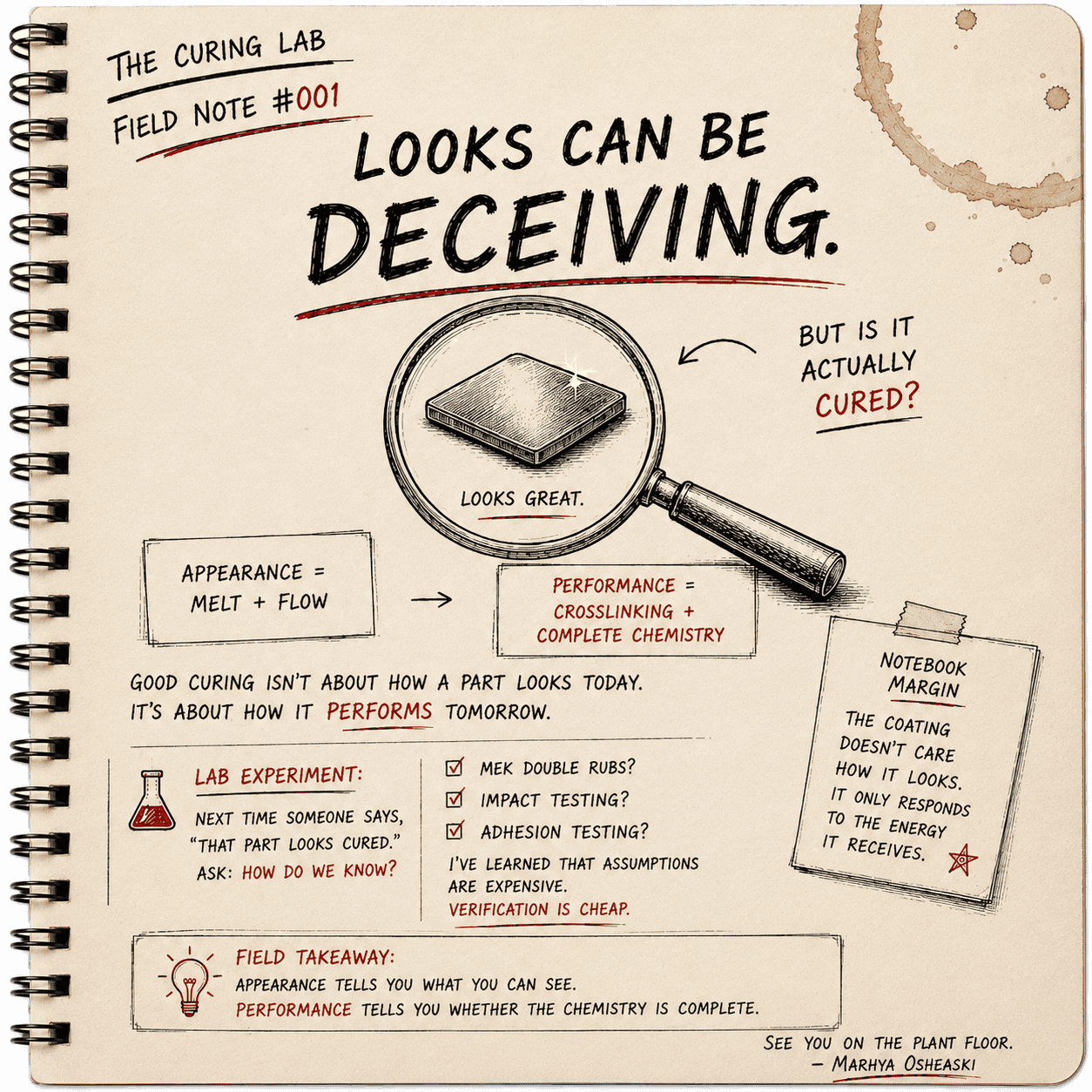
One of the most common things I hear when I’m walking through a manufacturing plant is:
“The coating looks great.”
And many times…
It does. Smooth. Glossy. A beautiful finish.
But the question I always ask is:
“How do you know it’s cured?”
Because appearance and cure are not the same thing. A coating can leave the oven looking excellent and still be under-cured. That’s because appearance is largely the result of melt and flow. Performance depends on what happens next.
As the coating continues to absorb energy, the resin system reaches the point where crosslinking begins. Those chemical bonds are what give the coating its long-term durability, chemical resistance, adhesion, hardness, and overall performance.
If sufficient energy isn’t delivered to complete that reaction, the coating may still look beautiful on day one.
The difference often doesn’t show up until later, often in the form of
- Reduced impact resistance.
- Poor solvent resistance.
- Loss of adhesion.
- Premature weathering.
When I’m evaluating a curing process, appearance is only the beginning.
The real question is whether the coating received the energy required to complete the chemistry it was designed to achieve.
Good curing isn’t about making a part look finished. It’s about making sure it actually is.