
From Space Constraint to Production Advantage
How American Tin Ceilings Increased Throughput Without Expanding Its Facility
Preserving a Craft, Facing a Constraint
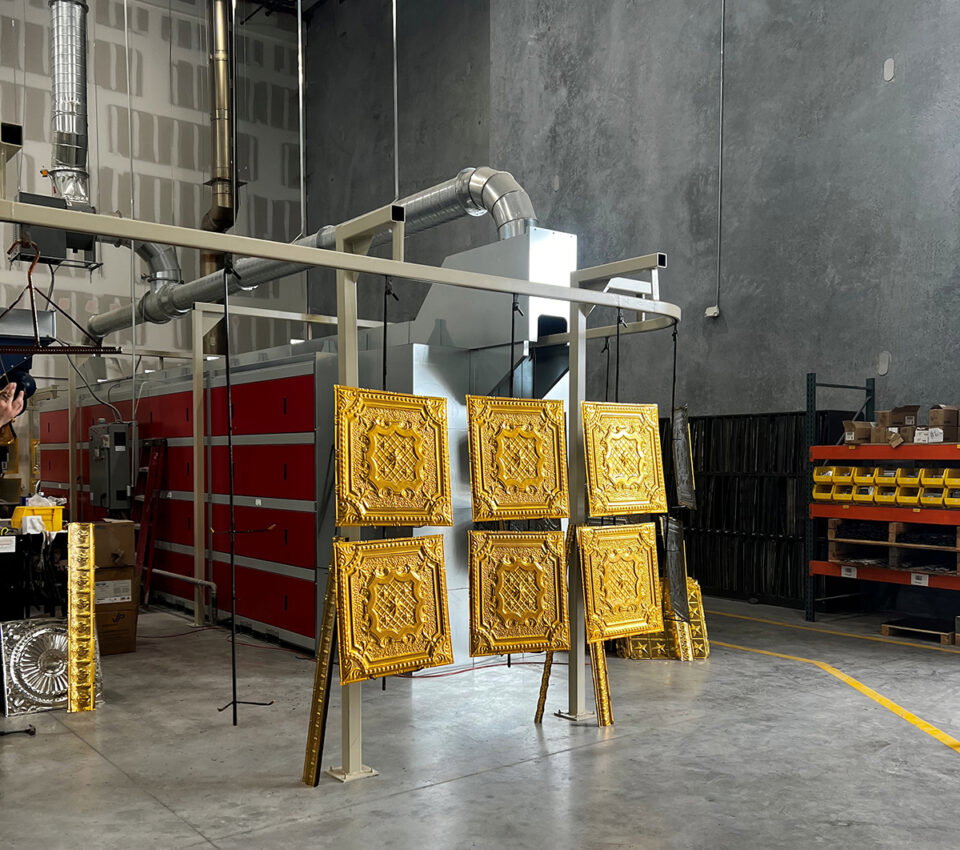
American Tin Ceilings was founded to preserve and revitalize a historic American craft. By bringing retro stamped metal ceiling designs back into homes and commercial spaces using domestically made tooling and manufacturing processes, the company built its reputation on authenticity, craftsmanship, and respect for tradition. What began as a focused effort to preserve classic patterns has evolved into a modern manufacturing operation serving a growing national market. As demand increased, the company faced a challenge familiar to many manufacturers: how to increase production capacity without dramatically increasing facility size, equipment costs, or operational complexity. A planned move into a new building made the challenge even more pressing. The team needed a finishing solution that could deliver more throughput, fit within a constrained footprint, and generate a rapid return on investment without requiring a complete redesign of their operation.
Finding the Solution and Proving It Out
Like many manufacturers evaluating growth opportunities, American Tin Ceilings began researching technologies that could improve production efficiency while reducing space requirements. That research led them to WolfRayet and its gas catalytic infrared curing technology, which has helped manufacturers across a wide range of industries increase throughput, reduce oven length, and improve operational efficiency in situations where space and budget are limited. After discussions with WolfRayet’s expert engineering team, American Tin Ceilings traveled to Texas to run production trials using their actual parts, coatings, and production parameters. The goal wasn’t simply to validate cure performance. The team wanted to understand exactly what was possible within the physical constraints of their new facility and determine whether a more compact thermal processing approach could support both immediate production goals and long-term growth plans.
What the Testing Revealed
The results quickly demonstrated that the opportunity extended far beyond curing speed alone. Working alongside WolfRayet’s engineering experts, American Tin Ceilings evaluated line speed, coating performance, energy usage, process repeatability, and overall production flow. The testing confirmed that WolfRayet technology could dramatically reduce the footprint required for curing while maintaining the finish quality their customers expect. More importantly, it opened the door to a line design that delivered increased throughput without requiring additional building space or costly facility modifications. For manufacturers facing similar constraints, this is often where the economics become compelling. By reducing oven length and maximizing production within existing space, companies can often achieve faster ROI than traditional expansion projects. Instead of investing in larger facilities, longer conveyor systems, or extensive infrastructure upgrades, manufacturers can frequently add or retrofit catalytic infrared technology into existing lines and realize meaningful operational improvements with a significantly lower capital investment.
Engineering Around the Product, Not Just the Oven
“This is exactly what our team does every day,” said Marhya Osheaski of WolfRayet. “We work closely with customers to engineer a solution around their product, their production requirements, and their budget. We’re not just looking at heat and ovens—we’re evaluating the entire manufacturing process to identify opportunities for efficiency, throughput, and long-term growth. In many cases, customers are getting a highly customized solution without paying a custom price tag.” That collaborative approach helped transform what initially appeared to be a space limitation into a production advantage.
Up and Running, With Results on the Floor
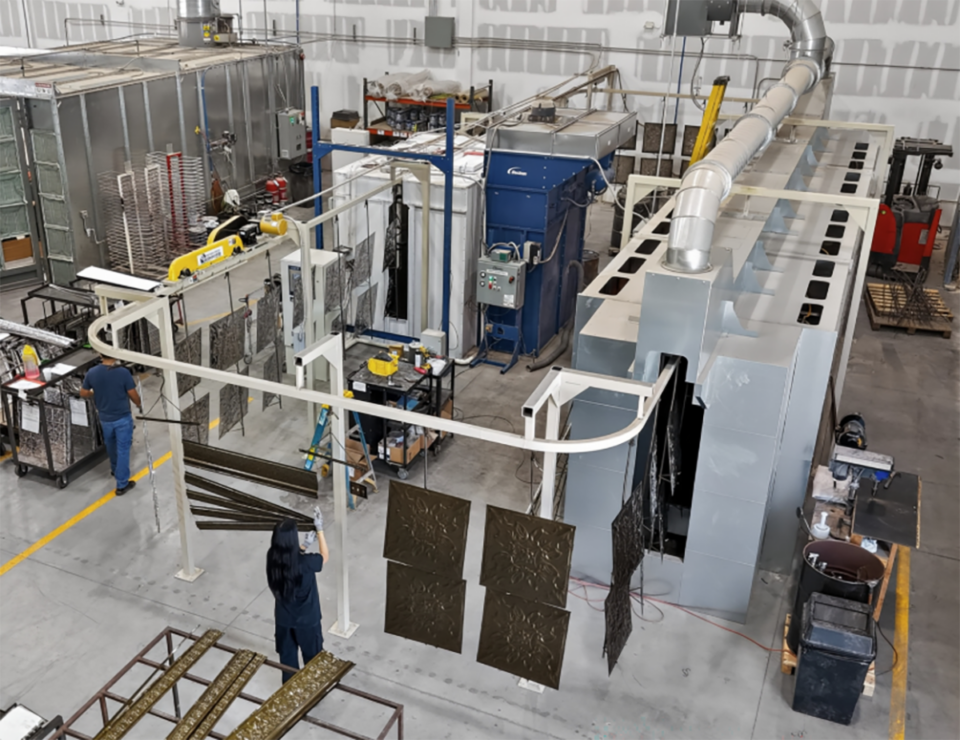
Fast forward to 2026, and American Tin Ceilings is fully operational in its new facility. The finishing line, installed and commissioned by PS & E, is anchored by a WolfRayet gas catalytic infrared oven engineered specifically around the company’s products, coatings, throughput goals, and facility constraints. The system is delivering exactly what the team hoped to achieve. Production targets are being met, valuable floor space has been preserved, and the compact curing system has provided flexibility for future growth without forcing compromises elsewhere in the facility. By reducing the amount of space traditionally required for thermal processing, the company was able to maximize production capacity while maintaining an efficient plant layout. “What impressed us most was how easy the WolfRayet team was to work with throughout the entire process,” said Riley Genz of American Tin Ceilings. “We came into the project with very specific requirements and a limited amount of available space. Honestly, we were surprised by what they were able to accomplish within those constraints. The production trials gave us confidence early on, and now that the line is running, we’re already seeing the results in throughput, efficiency, and overall operation. It’s been a great experience from start to finish.”
Growth Without More Square Footage
The project serves as a reminder that growth does not always require more square footage. Sometimes the fastest path to increased capacity comes from rethinking how heat is applied, how production flows, and how existing space can be utilized more effectively. For manufacturers facing space limitations, expansion challenges, or pressure to improve production without major capital expenditures, catalytic infrared technology offers an alternative path—one that can often be integrated into existing operations, deliver measurable operational improvements quickly, and generate ROI far sooner than traditional facility expansion projects. For American Tin Ceilings, the result is a manufacturing operation that successfully balances historic craftsmanship with modern production efficiency, creating room for continued growth without requiring a larger footprint.